
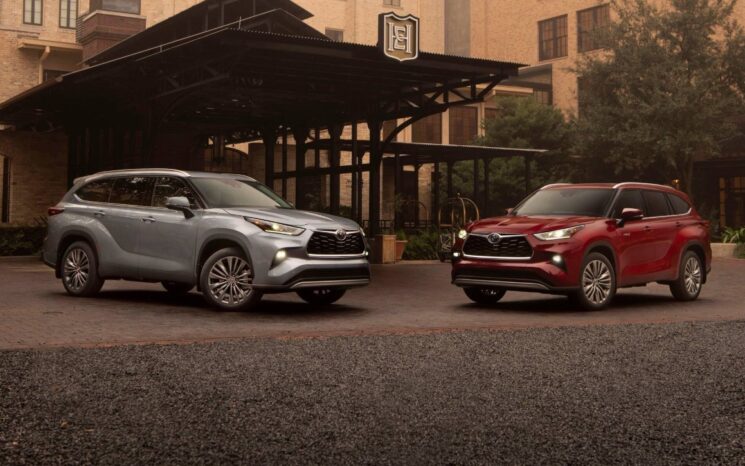
The Toyota Highlander helped define the car-based midsize SUV segment – a category buyers continue to flock to. On the market since 2001, this family-friendly crossover has evolved significantly over time, eventually prompting Toyota to expand the nameplate with the introduction of the new three-row Grand Highlander for the 2024 model year.
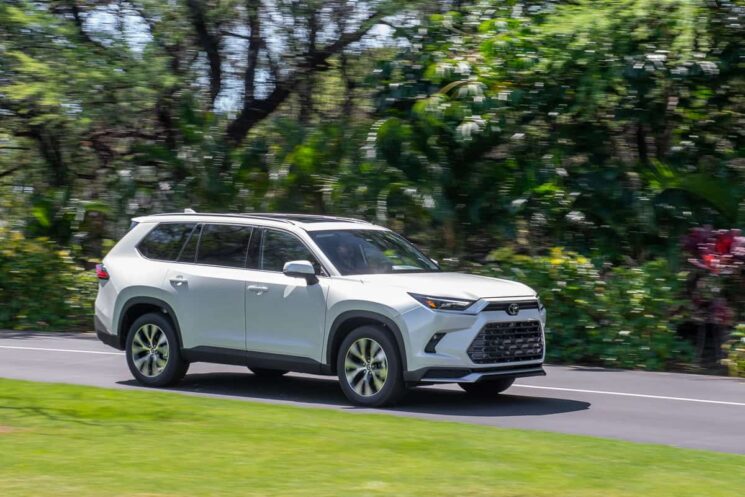
At launch, the Grand Highlander was viewed as more than just a larger version of the original, boasting key distinctions. Now, with the current Highlander lineup continuing in gasoline and hybrid form for the U.S. market, the two models are further apart than ever. Just how different are they? Below are the key differences between the two Highlanders.
Powertrain Options
When the Grand Highlander was first introduced, it featured the same 2.4-liter turbocharged inline-4 engine used in the Highlander. That remains true in the U.S. market today. The Highlander is available with a 2.4-liter turbocharged inline-4 engine producing 265 horsepower and is offered in front-wheel-drive or all-wheel-drive configurations. It is also available with a 2.5-liter hybrid powertrain delivering 243 combined horsepower and standard all-wheel drive. Fuel economy reaches up to 22/29/25 mpg (city/highway/combined) for gasoline models and up to 36/35/36 mpg for hybrid models.
The Grand Highlander, meanwhile, retains the same 2.4-liter base engine and is available with front- or all-wheel drive; however, it also offers versions with Toyota’s 2.5-liter hybrid powertrain or the turbocharged 2.4-liter Hybrid MAX system. Power output ranges from 265 hp (gas model) to a combined 362 hp with the Hybrid MAX system. The base front-wheel-drive gasoline model achieves fuel economy ratings of approximately 21/28/24 mpg (city/highway/combined), while the Hybrid MAX AWD variant manages about 26/27/27 mpg. The most efficient option is the 2.5-liter hybrid, delivering up to 37/34/36 mpg depending on configuration.
Technology
As newer and more advanced entries in Toyota’s lineup in Indiana dealerships like Indy Auto Man, both the Highlander and Grand Highlander feature the latest Toyota Audio multimedia system and Toyota Safety Sense 3.0 suite in the U.S. market.
Inside, the Highlander offers available dual wireless charging pads, a 12.3-inch digital instrument cluster on higher trims, and a 12.3-inch Toyota infotainment interface. While many functions are controlled via the touchscreen, physical controls, such as a volume knob and climate controls, remain. It also supports wireless Android Auto and Apple CarPlay and is available with an optional 11-speaker JBL premium audio system.
The Grand Highlander features similar technology but benefits from its larger cabin and added utility. It comes standard with a 12.3-inch multimedia touchscreen and offers a 12.3-inch digital instrument cluster on higher trims. It includes the same wireless charging pad and an 11-speaker JBL premium audio system. Additionally, it offers available 120-volt power outlets – rated up to 1,500 watts on hybrid models – making it more versatile for powering external devices.
Safety Features
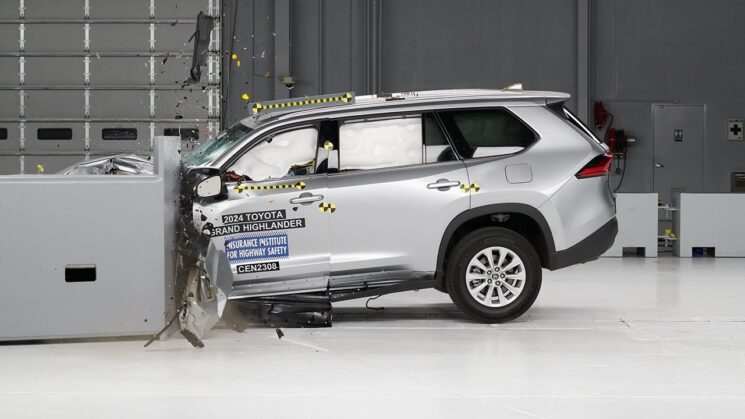
Both vehicles are equipped with the Toyota Safety Sense suite, but the Grand Highlander’s version 3.0 includes several enhancements, such as a pre-collision system with pedestrian detection, advanced adaptive cruise control, lane tracing and departure alert with steering assist, automatic high beams, road sign assist, and proactive driving assist. It also supports over-the-air (OTA) updates and enables limited hands-free driving in heavy traffic conditions, thanks to proactive driving assist and lane tracing assist.
The Highlander’s version of Toyota Safety Sense (2.5/2.5+) is equally capable in core features; it offers many of the same features but is more reactive than predictive. Thus, it lacks Proactive Driving Assist, lacks an emergency stop function, cannot receive OTA updates, and requires you to keep your hands on the steering wheel at all times.
Passenger Seating
Both vehicles come standard with three rows of seats. The Highlander is Toyota’s conventional hybrid three-row SUV. It accommodates up to seven people in a 2-3-2 configuration, or six with second-row captain’s chairs; meanwhile, the larger Grand Highlander offers seating for eight with a second-row bench seat in LE and XLE trims, or for seven with second-row captain’s chairs in Limited and Platinum trims.
Cargo Capacity
The Highlander offers a good amount of cargo space for a three-row SUV. With the third row in use, you have 16.0 cu ft of cargo space, which increases to 48.0 cu ft when that row is folded down. If you don’t need the second row, the total cargo volume rises to 84.6 cu ft when those seats are folded.
However, compared to the Grand Highlander, these figures are somewhat lower. With the third row in use, you get 20.4 cu ft of cargo space, and up to 57.7 cu ft when the third row is stowed. But if you need to haul as much gear as possible, the Grand Highlander offers up to 97.5 cu ft of total cargo volume when both the second and third rows are folded down.
Exterior Dimensions
In terms of size, the Highlander remains the smaller of the two SUVs, though it is catching up to its larger sibling in linear dimensions. It has an overall length of 198.9 inches and sits on a platform with a 120.5-inch wheelbase. The overall width is 78.0 inches (excluding side mirrors), and the overall height is 67.5 inches. The Grand Highlander is not much longer, measuring 201.4 inches in total length, though its platform utilizes a shorter wheelbase of 119.1 inches (295.9 cm). At 70.1 inches tall, it is the taller of the two, yet it shares the same width as the Highlander: 78.0 inches.
Trim Levels
The Highlander currently offers only two trim options: XLE and Limited. So, if you want plenty of choices regarding trim levels, the Grand Highlander is worth a look.
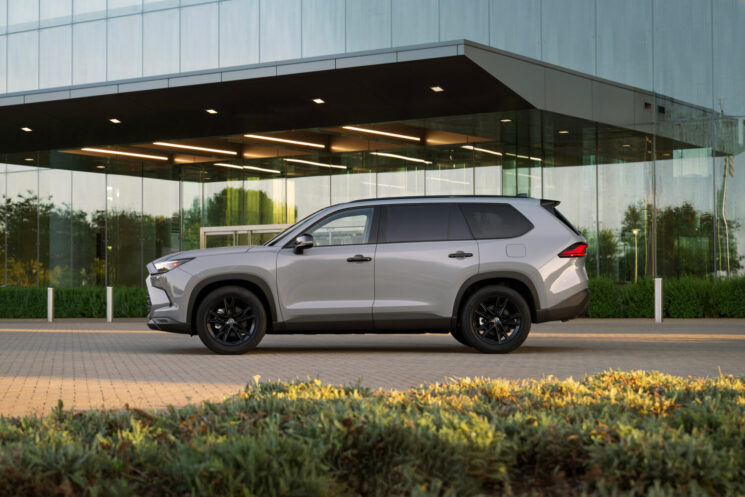
Beyond its three powertrain options (2.4L Turbo, Hybrid, Hybrid Max), it offers five distinct trim levels, starting with the LE. Next come the XLE, Limited, Nightshade, and Platinum trims, featuring a progressive increase in standard features, options, and pricing.